

Recently, the research team led by Professor Ge Yong from JXNU, in collaboration with multiple domestic and international research institutions including the Institute of Geographic Sciences and Natural Resources Research, Chinese Academy of Sciences, and the University of Southampton in the UK, published a research paper titled Future heat-related mortality in Europe driven by compound day-night heatwaves and demographic shifts in the internationally renowned journal Nature Communications (IF=15.7). Professor Ge Yong served as the corresponding author, with Jiangxi Normal University being the sole corresponding institution, and Dr. Zhang Die from JXNU as a co-author.
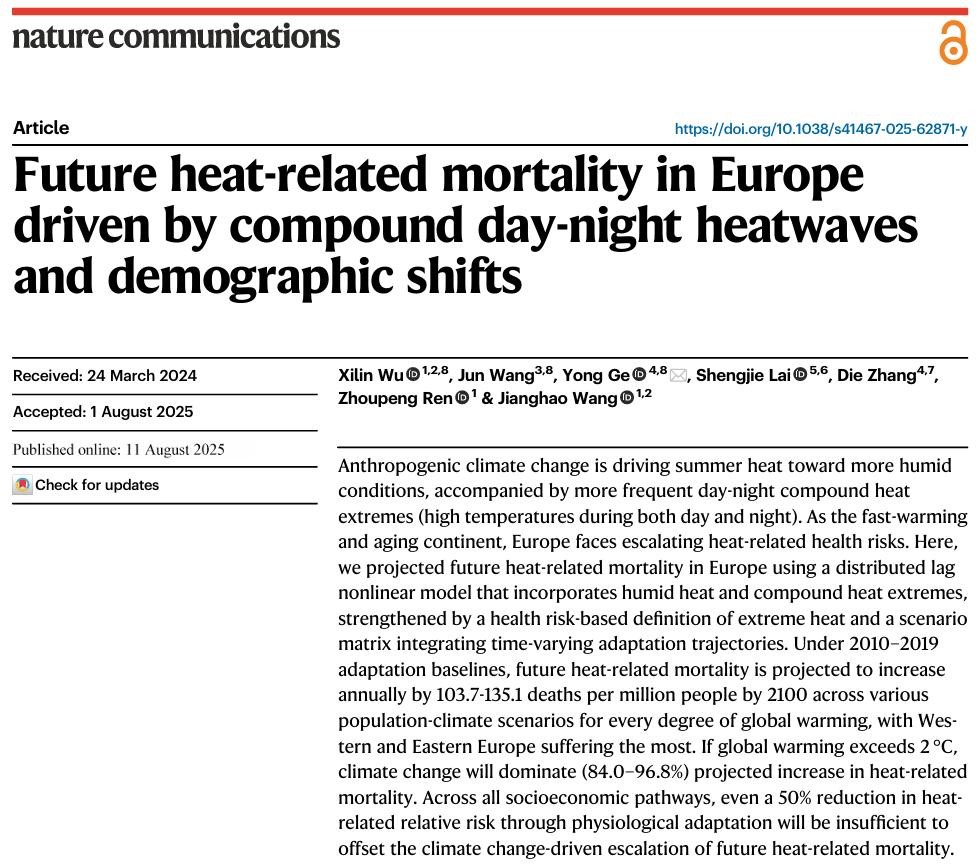
With the continuous rise in global temperatures, climate models predict that more regions will experience the combined effects of high temperatures and humidity in future summers, accompanied by increasingly frequent compound day-night heatwaves (where both daytime and nighttime temperatures exceed health risk thresholds). Europe, being not only a global warming hotspot but also facing the challenge of an aging population, is particularly sensitive to the health risks posed by such extreme heat events. In response, Professor Ge Yong's team constructed a comprehensive dataset covering all of Europe with high spatiotemporal resolution, incorporating the Humidex, a composite temperature-humidity index, and three categories of health risk-based extreme heat events.
This study offers an alarming projection for Europe's future under climate change. By elucidating the interaction between compound day-night heatwaves and demographic vulnerability, the research underscores the urgent need for integrated strategies that combine accelerated climate change mitigation with targeted public health adaptation measures, with a particular focus on protecting vulnerable elderly populations. Without effective interventions, Europe—along with other potentially affected regions—will face a significant rise in heat-related deaths in the coming decades.
Paper Link: https://doi.org/10.1038/s41467-025-62871-y

